Recently Seen in Omena Woods
By John Putnam
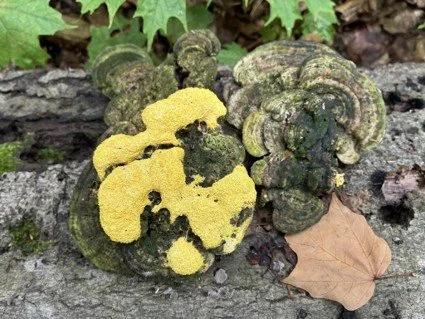
Dog Vomit Slime Mold
This bright blob is the inspired and aptly named Dog Vomit Slime Mold (Fuligo septica). It’s a huge single cell with many nuclei — so it’s not an animal, fungus, or plant, all of which are multicellular. Baffled scientists instead group it with other single-celled nucleated organisms called protists.
Amoeba-like, slime molds slowly ooze through the forest’s decaying wood and leaf litter, feasting on the bacteria that feed on the rotting matter. Despite being brainless, they can solve mazes, anticipate food, and even communicate.
Intrigued? Read more: Slime Molds | Brainless Slime Molds
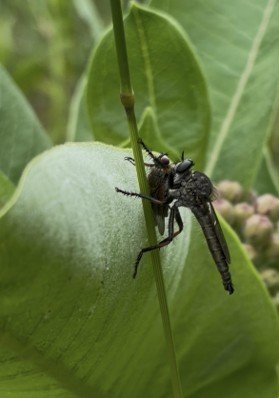
Black-thighed Bladetail Robber Fly
This photo of a Black-thighed Bladetail Robber Fly (Machimus notatus) was taken in the Meadow — caught mid-feast on a smaller, unidentified fly. Like many robber flies, it’s an ambush predator, darting out from a perch to snatch nearby prey. It then impales its catch with its mouthparts, injects digestive juices, and sucks out the nutritious slurry, leaving behind an empty husk.
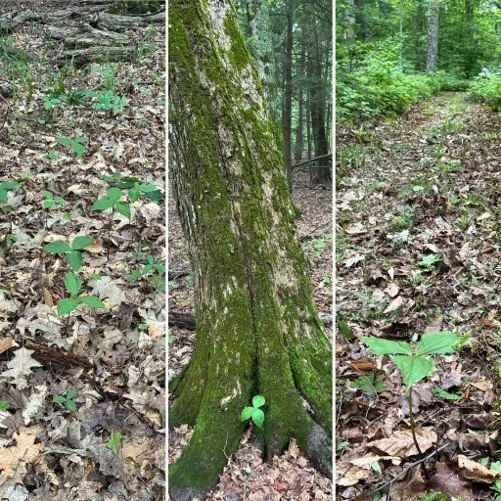
Trilliums in the Woods
Trilliums from the Woods shown here, left to right, in abundance, protected by a maple, and staking a claim in the middle of the South Loop trail.
Have you seen the white Trillium (Trillium grandiflorum) in our Woods? They’re done blooming now having bloomed in late Spring, but once you get a search image for young trillium in your mind, you’ll spot them everywhere.
Trilliums are as unusual as they are beautiful:
● They take 7–10 years to mature before their first bloom.
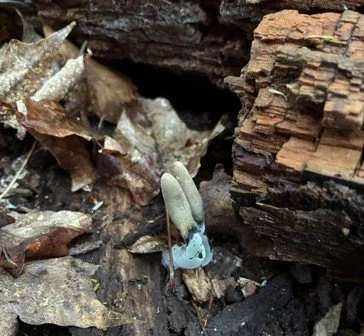
Dead Man’s Fingers
All the recent rain has brought out some mushrooms in the Woods, including the grisly named Dead Man’s Fingers (Xylaria polymorpha). Once you learn to recognize it, it’s hard not to see a corpse’s hand reaching for the canopy.
This fungus decomposes dead wood — like the beech and maples in our Woods — by breaking down the glue binding wood’s two main components, cellulose and lignin. (Other fungi specialize in one or the other: brown rot breaks down cellulose, white rot breaks down lignin.) Later in the year, Dead Man’s Fingers turn charcoal black. Disappointingly, it’s NOT edible!
● They’re perennials — some live 70–80 years.
●Ants spread their seeds, drawn by a tasty attachment
● Each plant produces just 15–50 seeds a year
More on these fascinating plants in an upcoming article!